Cloud Penetration Testing
Identify misconfigurations, privilege escalation paths, and exposed assets across your cloud environment before attackers find them.
Cloud Pentest Agent Workflow
A manager agent coordinates specialist agents in parallel, then validates, evidences, and scores findings before a human reviews the report.
Pentest Manager Agent
Coordinates the engagement, assigns specialist agents, and keeps the test in scope.
Recon Agent
Maps cloud assets, identities, public exposure, and attack surface.
Authentication Agent
Tests IAM, federation, tokens, privilege boundaries, and access paths.
API Security Agent
Assesses APIs, gateways, authz, data exposure, and cloud-connected services.
Validation Agent
Confirms each finding is real, reproducible, and in scope.
Evidence Agent
Collects proof, screenshots, logs, and reproduction notes.
Severity Agent
Rates impact and likelihood using CVSS and business context.
Reporting Agent
Turns findings into a developer-ready report with fix guidance.
Human Review
A senior engineer reviews every finding before delivery.
How it works
1. Orchestrate
The Pentest Manager Agent scopes the cloud environment and assigns specialist agents.
2. Investigate in parallel
Recon, Authentication, and API Security agents run together to cover more of the attack surface.
3. Validate and prove
Validation and Evidence agents confirm each issue and attach reproduction steps.
4. Score and report
Severity and Reporting agents produce a ranked report, then a human reviews it before you receive it.
Benefits
AI + Human platform
Cloud testing runs on our AI + Human Penetration Testing Platform — AI-assisted discovery with senior engineer validation.
Broader coverage, faster
Specialist agents work in parallel so IAM, APIs, and exposed assets are tested together — not one after another.
Fewer false positives
Every candidate finding is validated and evidenced before it reaches the report.
Actionable severity
Issues are scored by real cloud impact: data exposure, privilege escalation, and blast radius.
Human quality control
A senior engineer still reviews the output, so you get speed without losing judgment.
Why your applications need this
Cloud-hosted applications change constantly. New identities, APIs, buckets, and services appear with every deploy. A point-in-time checklist scan is not enough — you need a structured assessment that follows how attackers actually move through cloud environments. Built on our AI + Human Penetration Testing Platform.
Cloud identity is the new perimeter
Most cloud breaches start with IAM mistakes, over-privileged roles, or leaked credentials — not a classic firewall gap.
APIs expose the business
Your application logic now lives behind APIs and gateways. If authz is weak, attackers can reach data without touching the UI.
Misconfigurations spread quickly
One public bucket, open security group, or wildcard policy can expose production data across accounts.
Compliance still requires proof
Audits and customers expect evidence that cloud controls were tested, validated, and reported with severity.
Why Choose Cloud Penetration Testing?
Misconfiguration Detection
Find publicly exposed buckets, open security groups, and weak IAM policies.
Privilege Escalation
Map attack paths from low-privilege access to admin control.
Multi-Cloud Support
Testing across AWS, Azure, GCP, and hybrid environments.
Compliance Alignment
Reports mapped to CIS benchmarks and cloud security frameworks.
What is Cloud Penetration Testing?
Cloud penetration testing evaluates your cloud infrastructure for security weaknesses unique to cloud environments — misconfigured IAM roles, exposed storage, overly permissive network policies, and secrets in code or environment variables. We simulate attacker techniques to validate your cloud security posture end to end.
- IAM & role policy review
- Storage & database exposure
- Network & firewall analysis
- Secrets & credential scanning
- Container & Kubernetes review
- Serverless function assessment
What We Assess
Aligned with Industry Standards
Our cloud assessments follow CIS, NIST, ISO 27001, SOC 2, and MITRE ATT&CK so findings map to frameworks your auditors and customers already use.
Assessment Process
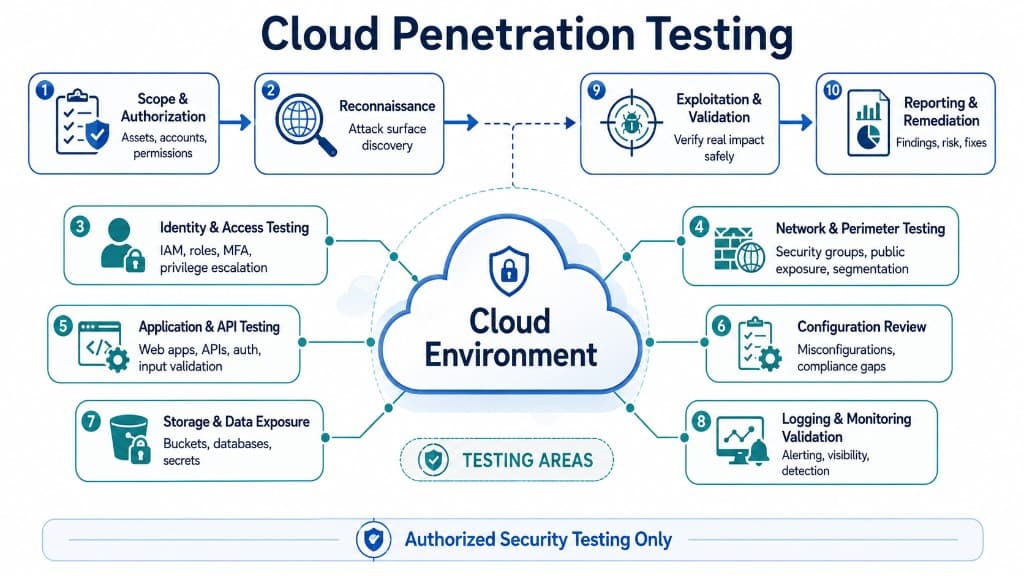
A structured engagement from written authorization through reconnaissance, configuration review, safe validation, and hardening guidance.
Scope & Authorization
Agree assets, accounts, permissions, and rules of engagement.
Reconnaissance
Discover cloud assets, identities, and public attack surface.
Configuration Review
Hunt IAM gaps, exposed storage, network holes, and secrets.
Exploitation & Validation
Prove privilege escalation and real impact without disruption.
Reporting & Hardening
Deliver findings, risk ratings, and cloud-specific fix guidance.
Tools & Technologies
Professional Security Reports
Industries We Support
What You'll Receive
Executive Summary
- Cloud posture overview
- Critical risks
- Compliance gaps
Technical Report
- Misconfiguration details
- Attack paths
- IAM findings
- Evidence
- CVSS scores
Hardening Guide
- Cloud-specific fixes
- IAM recommendations
- Architecture notes
Retest Report
- Fix validation
- Updated posture
- Final report
Frequently Asked Questions
Which cloud providers do you support?+
AWS, Microsoft Azure, and Google Cloud Platform, including hybrid setups.
Do you need admin access?+
Read-only or limited access is preferred. We scope access levels during kickoff.
Will this disrupt our cloud services?+
No. Testing is non-destructive and coordinated with your team.
Can you test Kubernetes?+
Yes. Container and Kubernetes security is included in cloud engagements.
Ready to harden your cloud environment?
Gain visibility into cloud misconfigurations and attack paths before they're exploited.